
EXCLUSIVE: The VIPs of Western Balkan Business


The VIPs of Western Balkan Business
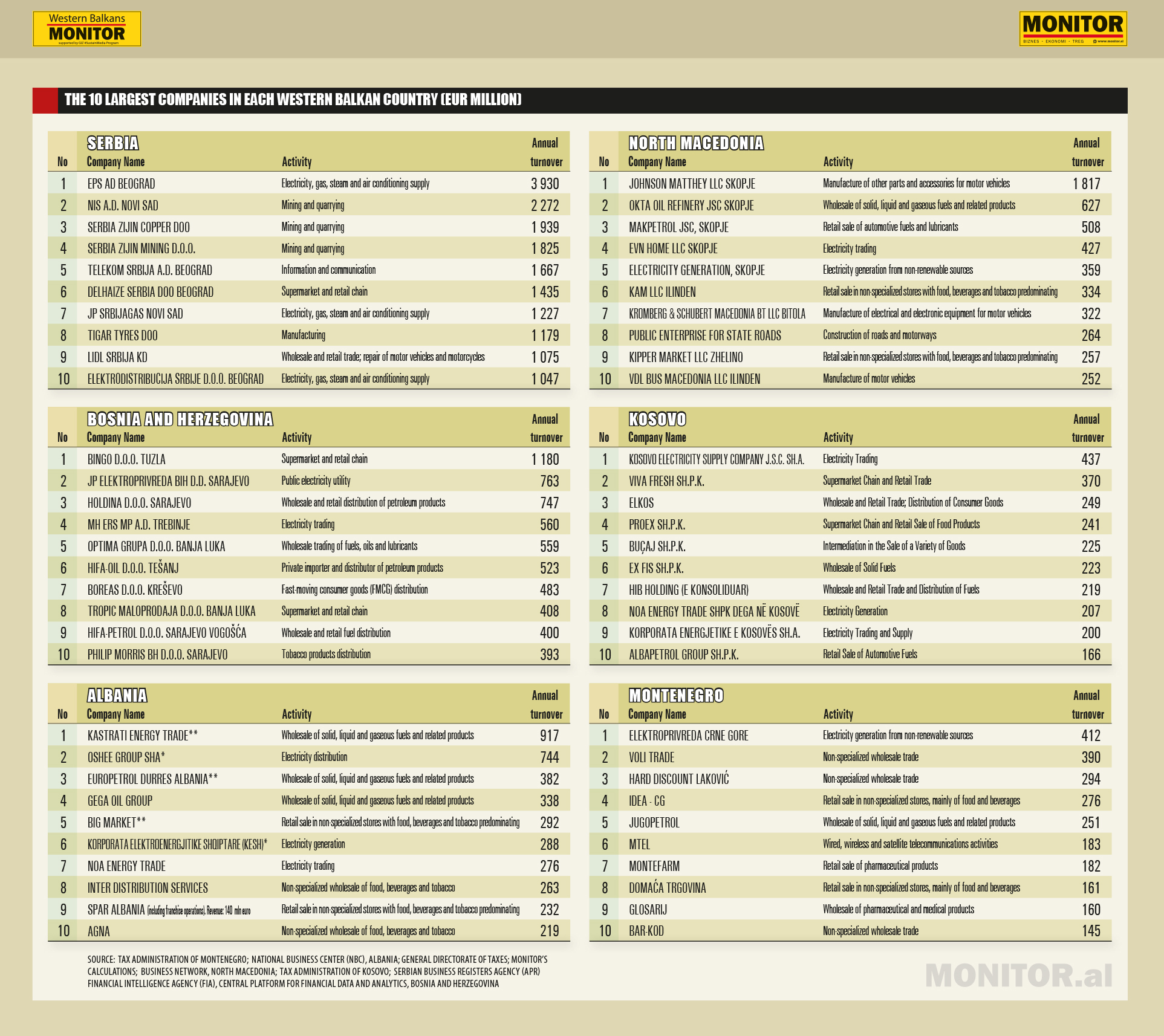
For the first time, Monitor publishes a regional ranking of the largest companies in the Western Balkans by revenue. Serbia dominates with its energy, mining and industrial giants, while North Macedonia stands out for automotive manufacturers supplying European markets. In Albania, billions flow primarily through fuel trading the energy sector and construction; in Bosnia and Herzegovina, a supermarket chain is the country’s largest business. Kosovo and Montenegro rely heavily on energy, trade and consumption. Supermarket chains are emerging as the region’s new corporate giants, while relatively few domestically owned companies have expanded beyond national borders. Six economies, six business models — but how many are truly creating value, and how many are simply generating turnover?
Ornela Liperi
In the Western Balkans, the size of a company does not always reveal how much an economy actually produces. Serbia is home to energy and mining giants, North Macedonia to automotive manufacturers supplying European markets, while Albania’s corporate rankings are led by fuel traders and energy companies. In Bosnia and Herzegovina, a supermarket chain has become the country’s largest business, while energy, trade and services dominate in Kosovo and Montenegro.
These are some of the defining characteristics emerging from an analysis of the largest companies in the six Western Balkan economies in 2025.
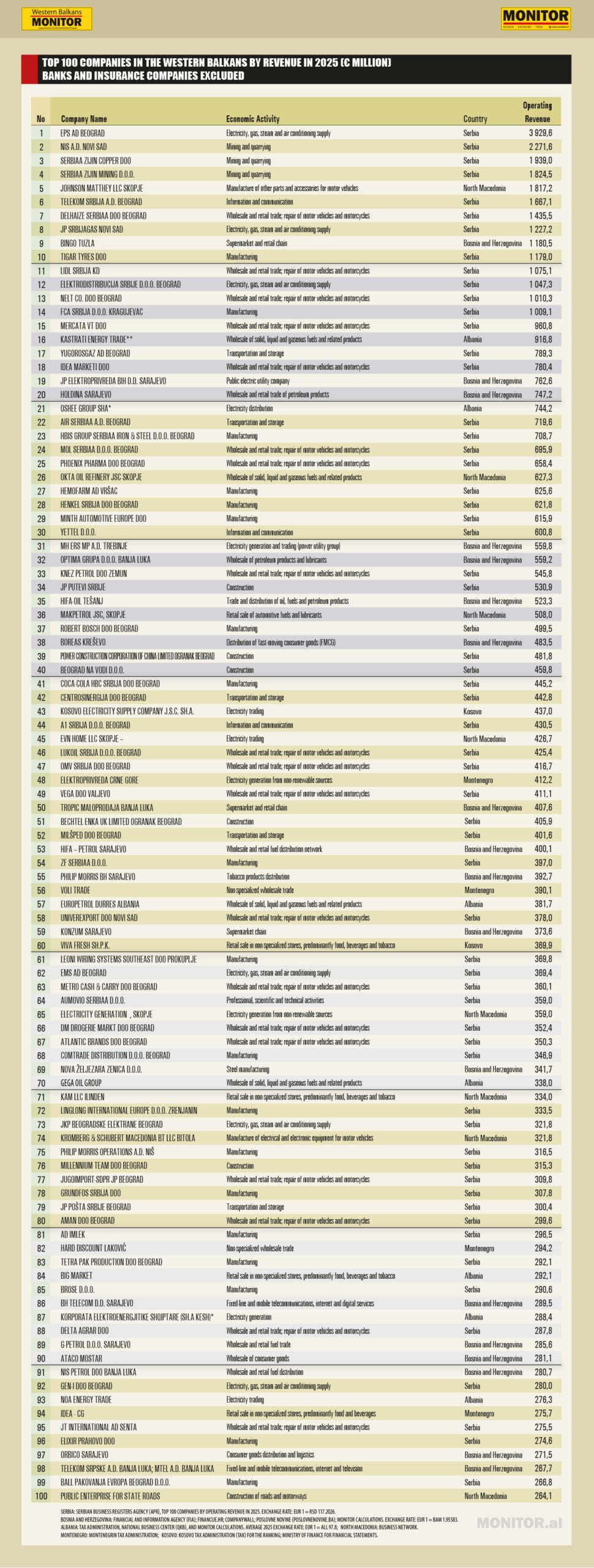
For the first time, Monitor is publishing a regional ranking covering the 50–100 largest companies in the Western Balkans by revenue, based on financial data published in the respective countries.
The ranking is part of Western Balkans Monitor, a dedicated section providing comparative analysis of the region’s economies, alongside reporting by our correspondents in Kosovo, Serbia, North Macedonia, Montenegro and Bosnia and Herzegovina. This section is supported by the GIZ Regional Programme #SustainMedia, funded by the European Union (EU) and the German Government (BMZ)[1].
The ranking covers non-financial businesses only. Financial institutions, including banks and insurance companies, are excluded and presented in separate rankings (see the section following the company rankings for the six economies).
Serbia dominates in terms of corporate size, while North Macedonia stands out for the prominence of manufacturing companies. Serbia’s ten largest enterprises generated approximately €17.6 billion in revenue, accounting for almost half the combined turnover of the 60 companies featured in the six national top-ten rankings. This largely reflects the scale of Serbia’s economy: with GDP of around €89 billion, it accounts for approximately half of the Western Balkans’ combined economic output.
The region’s largest company is Serbia’s state-owned electricity producer, EPS, with revenue of €3.93 billion. It is followed by oil company NIS, with €2.27 billion. Serbia’s top ten also includes two Chinese-owned mining giants, Serbia Zijin Copper and Serbia Zijin Mining, with revenues of €1.94 billion and €1.82 billion, respectively.
Energy and fuel businesses feature prominently in almost every economy in the region. The nature of these activities, involving large volumes of relatively high-value commodities, can generate substantial turnover even with a limited workforce. As a result, rankings based on revenue do not necessarily reflect companies’ contributions to employment or economic value added.
One of the most revealing contrasts is between Albania and North Macedonia. Although North Macedonia’s economy is around 40% smaller than Albania’s, its largest company, Johnson Matthey, generated €1.82 billion in revenue — almost twice the €917 million reported by Kastrati Energy Trade, Albania’s largest company. (See the section “North Macedonia vs Albania: Jobs Versus Turnover.”)
Johnson Matthey manufactures catalysts for the automotive industry and is one of the clearest examples of North Macedonia’s strategy of attracting manufacturing investment through free economic zones. The country’s ten largest companies also include Kromberg & Schubert and VDL Bus Macedonia, both linked to the automotive industry.
Albania presents a very different picture. Its largest-company rankings are dominated by fuel trading, electricity distribution and generation, and wholesale and retail trade. Manufacturing companies are absent from the top ten, reflecting the weakness of the country’s industrial base.
According to Eurostat data, industry contributes only around 10% of Albania’s GDP, compared with approximately 17–18% in Serbia, North Macedonia and Bosnia and Herzegovina.
In Bosnia and Herzegovina, Bingo leads the ranking with revenue of approximately €1.18 billion. This is an unusual case in which a supermarket chain has overtaken state-owned energy utilities and major fuel traders. Although the country has a substantial industrial base, trade and energy dominate its ten largest companies by turnover.
In Kosovo, the largest company is KESCO, owned by the Turkish groups Limak and Çalık. The company supplies electricity to the Kosovo market and generated €437 million in revenue.
In Montenegro, the ranking is led by Elektroprivreda Crne Gore, the state-owned electricity generation, trading and supply company, with revenue of €412 million.
In both economies, retail chains also account for a significant share of the largest-company rankings, reflecting their greater reliance on consumption and services.
These differences are not accidental. They reflect the distinct paths along which the region’s economies have developed.
Serbia has benefited from the size of its domestic market and its industrial base, North Macedonia from foreign investment in manufacturing, while Bosnia and Herzegovina has benefited from its industrial heritage, particularly in metal processing and the wood industry, as well as the expansion of major retail chains. Montenegro’s economy is primarily oriented towards tourism and services. Albania, meanwhile, has increasingly directed economic activity towards construction, trade and services. Kosovo remains heavily dependent on consumption, trade and services, supported to a considerable extent by remittances from its diaspora.
Amer Kapetanović, Secretary General of the Regional Cooperation Council (RCC), a regional organisation dedicated to strengthening economic and political cooperation among Southeast European countries, promoting regional integration and accelerating their progress towards the European Union, said that ss Monitor prepares its ranking of the largest companies in the region, it is worth asking what that ranking should look like ten years from now. “How many of our leading companies will operate across several economies? How many will have developed regional supplier networks, their own technologies or internationally recognised brands? We need more such companies. Strong regional businesses can bring smaller suppliers into wider production networks, invest in innovation, create better-paid jobs and attract international partners”, Mr. Kapetanović said in an op-ed written exclusively for Monitor magazine.
A Common Market, but Limited Cross-Border Business Integration
Although the Western Balkans aims to function as a common market of approximately 17 million consumers, the largest companies in the six countries remain primarily focused on their domestic markets. The 2025 rankings show relatively few cases of cross-border investment by companies from within the region, while the presence of subsidiaries of international groups operating in several countries is far more pronounced.
The integration of domestic capital is more advanced in consumer goods distribution, logistics, telecommunications and trade. Serbia is home to some of the companies with the broadest regional presence, benefiting in part from the size of its economy.
Serbia’s Nelt Group, which specializes in consumer goods distribution and logistics, operates across almost the entire Western Balkans. In 2025, Nelt Co. generated €1.01 billion in revenue in Serbia, while its subsidiaries in Montenegro and Albania recorded €70 million and €42 million, respectively. The group also operates in Kosovo, North Macedonia and Bosnia and Herzegovina.
Delta Holding, also of Serbian origin, has expanded beyond its domestic market into distribution, agriculture, logistics and e-commerce, including the Ananas platform. In Serbia’s corporate ranking, Delta Agrar generated approximately €288 million in revenue. Milšped, the Serbian transport and logistics company, with revenue of around €402 million, also provides services in Albania, Montenegro and Bosnia and Herzegovina.
In the food industry, Imlek, which was acquired by Serbian investors in April 2026, has spent years building a regional network through acquisitions of dairy companies, including Bimilk in North Macedonia and Mlijekoprodukt in Bosnia and Herzegovina. In 2025, Imlek generated approximately €296 million in revenue in Serbia, while Imlek Boka recorded €35.6 million in Montenegro. This is one of the cases where expansion has taken place through the integration of manufacturing operations, rather than simply through the trading of goods.
In telecommunications, Telekom Srbija has one of the largest regional business structures. The group, which generated €1.67 billion in revenue in Serbia, controls the Mtel operator in Bosnia and Herzegovina and directly owns 51% of MTEL in Montenegro, while the remaining 49% is owned by the Bosnian operator it controls. The Montenegrin company generated approximately €183 million in revenue in 2025.
Retail trade has also created networks operating across several countries. Sport Vision, a group developed in the region, operates stores in Serbia, Montenegro, Albania, North Macedonia and other markets. In the 2025 rankings, the Serbian company generated approximately €205 million in revenue, while its Montenegrin counterpart recorded around €40 million. In electronics distribution, Comtrade Distribution generated approximately €347 million in revenue in Serbia and €32 million in Montenegro.
Companies from Bosnia and Herzegovina have also expanded into neighboring markets, particularly Montenegro. Hifa-Oil, with revenue of €523 million in Bosnia and Herzegovina, operates in the Montenegrin market through Hifa Oil CG, which generated €57 million. Consumer goods distributor ATACO, with revenue of €281 million in Bosnia and Herzegovina, is also present in Montenegro through a subsidiary with turnover of approximately €28 million.
From Albania, BALFIN is one of the groups with the broadest regional presence, operating in electronics retail, real estate and other activities. The Neptun retail chain alone generated approximately €97 million in revenue in Albania and €103 million in North Macedonia, while the group also operates in Kosovo.
The Albanian company NOA Energy Trade, which specializes in electricity trading and supply, has also expanded into Kosovo, where its subsidiary ranks among the country’s ten largest companies by revenue in 2025.
A more recent development is the regional expansion of Kosovo-based capital through Viva Fresh. The group, which generated €370 million in revenue in Kosovo, acquired SPAR Albania in 2025 for €36.4 million. In North Macedonia, it has also obtained the license to develop the SPAR retail network, building on the group’s existing operations in that market. This is an example of a company that grew in a relatively small economy and is now establishing a regional retail network.
Nevertheless, many of the names appearing repeatedly in the rankings of the Western Balkans’ largest companies do not represent cross-border investment by domestically owned businesses. GEN-I is a Slovenian group, Lidl is German and A1 is Austrian, while Coca-Cola HBC, Philip Morris, Lukoil and dm belong to international groups. In these cases, companies operating in several countries are controlled by the same parent companies headquartered outside the Western Balkans.
Banking and Insurance: Greater Regional Integration
In the banking sector, international groups such as Raiffeisen, OTP, Intesa Sanpaolo and UniCredit have the broadest regional presence. Slovenia’s NLB Group operates in five of the six Western Balkan economies, generating combined revenue of €871 million in 2025.
Albania is the only market in the region where the group does not yet operate, but NLB has expressed interest in entering the Albanian banking market. “Our ambition is to have banking operations in all Western Balkan markets,” said Blaž Brodnjak, CEO of NLB Group, in an interview with Monitor in February 2026. According to Brodnjak, entering Albania would complete the group’s regional presence and strengthen its integrated financial network, supporting cross-border capital flows.
There are also examples of direct investment between countries within the region. Serbia’s AIK Group operates in Serbia and Montenegro through AIK Banka and Hipotekarna Banka, with combined revenue of €447 million. Serbia’s state-owned Poštanska Štedionica also operates in Republika Srpska, Bosnia and Herzegovina, while BKT is present in Albania and Kosovo, with total revenue of €334 million. Although BKT is a bank of Albanian origin, it is controlled by Turkish capital.
Regional integration is also evident in the insurance sector, where the 10 largest groups account for approximately 73% of total gross written premiums. Serbia’s state-controlled Dunav Group, the region’s largest insurer with €445 million in premiums, operates in Serbia and Republika Srpska, Bosnia and Herzegovina.
Albania’s Sigal Insurance Group is one of the most significant examples of capital originating in a Western Balkan country expanding into neighboring markets. The group leads the insurance markets in Albania and Kosovo and also operates in North Macedonia. In 2025, Sigal generated €136 million in gross written premiums across the region and €25.7 million in pre-tax profit.
Slovenian insurance groups Triglav and Sava also have a significant regional presence, alongside Austrian groups Vienna Insurance Group and Grawe, which operate in several Western Balkan markets.
Supermarket Chains: The Retail Giants Dominating Trade in the Western Balkans
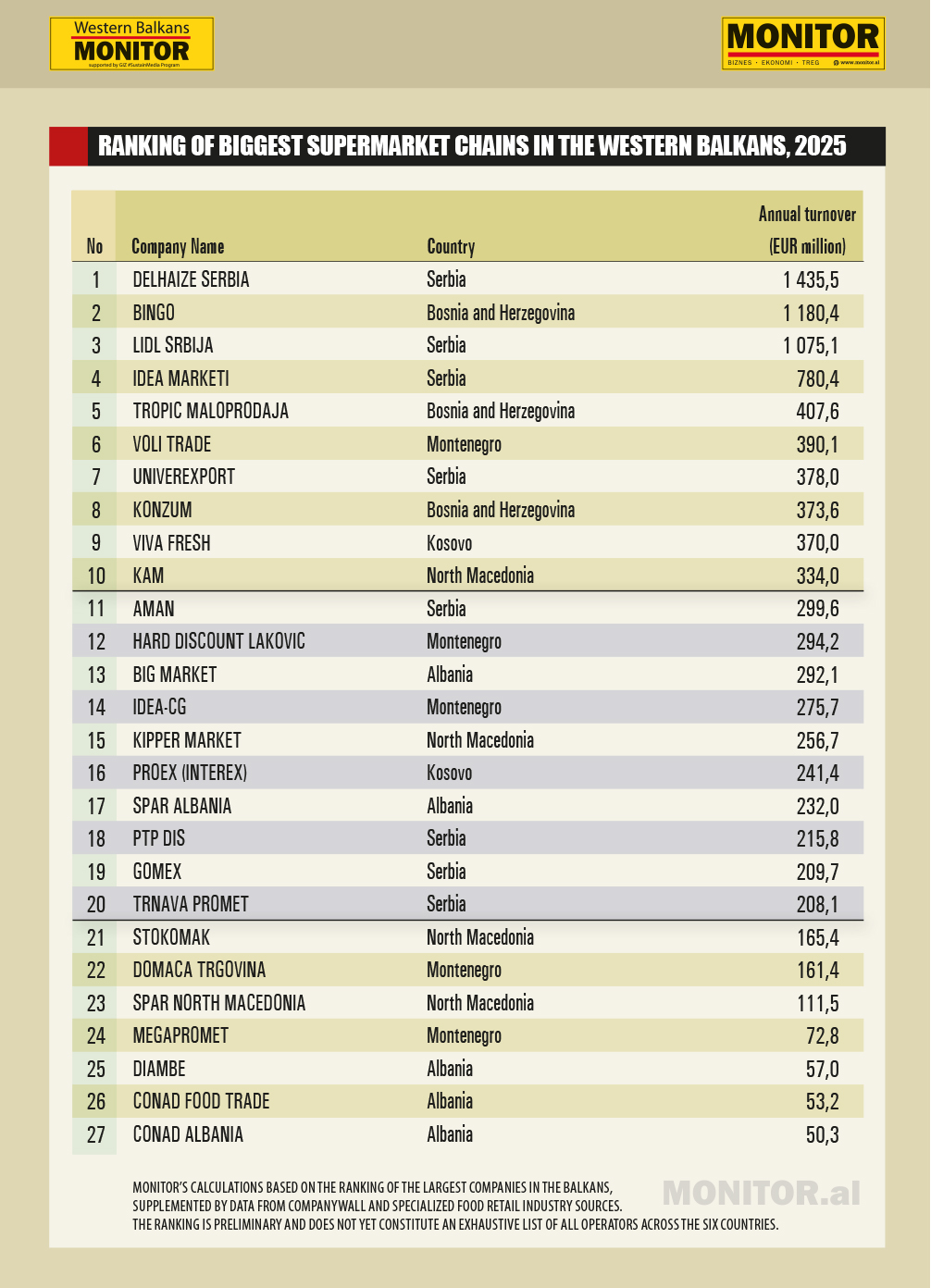
In a region where the largest companies are typically associated with energy, oil and industry, supermarket chains have emerged as some of the highest-revenue businesses. From Serbia to Bosnia and Herzegovina and North Macedonia, and from Montenegro to Kosovo and Albania, grocery retail is becoming increasingly concentrated in large chains. These retailers are gaining ground over traditional shops and accounting for a growing share of economic activity.
The clearest example is Bosnia and Herzegovina, where Bingo, with revenue of €1.18 billion in 2025, is the country’s largest company, surpassing even energy operators and major oil traders. Other major grocery retailers include Tropic Maloprodaja and Konzum, with revenues of €408 million and €374 million, respectively.
In Serbia, the two international chains Delhaize and Lidl generated combined revenue of more than €2.5 billion. Delhaize, with €1.44 billion, is the largest supermarket operator in the Western Balkans, followed by Bingo and Lidl Serbia, the latter generating €1.08 billion. The Serbian market is also home to other major operators, including IDEA Marketi, with revenue of €780 million, Univerexport with €378 million, and Aman with approximately €300 million. Together, these five grocery retail companies generated nearly €4 billion in turnover.
Supermarket chains also have a significant presence in the region’s smaller economies. In Montenegro, three of the country’s ten largest companies are grocery retailers: Voli Trade (€390 million), Hard Discount Laković (€294 million) and IDEA-CG (€276 million). In North Macedonia, KAM and Kipper Market generated revenues of €334 million and €257 million, respectively.
In Kosovo, Viva Fresh is among the country’s largest companies, with revenue of approximately €370 million, while Proex (Interex) generated around €241 million. In Albania, the market is still developing, with its largest operator generating less revenue than the leading chains in Montenegro and Kosovo, despite those countries having smaller consumer markets. Big Market in Albania leads the supermarket chains identified in the ranking, with revenue of €292 million, followed by Spar Albania at €232 million, including franchise operations.
The expansion of supermarket chains across the Balkans reflects the gradual transition from traditional retail to modern retail formats, investment in logistics, large-scale purchasing and greater bargaining power with suppliers. Rising consumption and the spread of discount retail models have also favored companies capable of reducing costs and increasing sales volumes.
However, the prominence of supermarket chains among the largest companies is not unique to the Balkans. In developed economies, grocery retail also produces corporate giants whose revenues rival those of major industrial and energy companies.
According to SeeNews’ SEE TOP 100 ranking, Lidl Discount in Romania was the third-largest company in Southeastern Europe in 2024, generating almost €5 billion in revenue, behind energy giant OMV Petrom and car manufacturer Dacia.
In the United States, Walmart topped the 2025 Fortune 500 ranking. In Europe, Germany’s Schwarz Group, owner of Lidl and Kaufland, generated €185.6 billion in revenue in the 2025 financial year, according to the company’s official figures. Tesco is also among the highest-revenue companies in the United Kingdom.
Nevertheless, in more developed economies, supermarket chains compete alongside a broad range of industrial, technology and financial giants. In the Western Balkans, where industry is less developed and markets are smaller, these retail chains are able to surpass a large share of manufacturing companies in terms of revenue.
Domestic Supermarket Chains Dominate, but Lidl Is Set to Intensify Competition
Despite the expansion of international retailers, many of the largest supermarket chains remain domestically owned. Bingo in Bosnia and Herzegovina, Voli Trade and Hard Discount Laković in Montenegro, KAM and Kipper Market in North Macedonia, Viva Fresh in Kosovo, and Big Market in Albania are examples of local businesses that have successfully competed with international operators. The most notable exceptions are Delhaize (Dutch-Belgian) and Lidl (German) in Serbia.
Meanwhile, the market is also witnessing cross-border expansion by domestic companies. In 2025, Kosovo-based Viva Fresh acquired SPAR Albania from the BALFIN Group for €36.4 million, marking one of the examples of regional investment in food retail.
In mid-2026, SPAR Albania acquired the Eco Market supermarket chain in Albania and signed an agreement with Kombinati i Mishit Yzberisht (KMY) to purchase its stores with a floor area exceeding 300 square metres. The two transactions involved the acquisition of 16 Eco Market stores and six KMY stores.
Through these latest acquisitions, SPAR Albania has further strengthened its position in the retail market, bringing its total network to 124 stores, including franchised outlets, according to official sources.
The Kosovo-based company is also expanding into the North Macedonian market. Following its acquisition of North Macedonia’s Kit Go chain in 2022, Viva Fresh also obtained the license to operate the SPAR brand in North Macedonia in 2026, according to official sources. The group plans to convert 65 existing stores into SPAR outlets.
Competition is expected to intensify further as Lidl expands across the Western Balkans. The German discount retailer, which has operated in Serbia since 2018, has been preparing to enter the Albanian market for several years. The company has been granted strategic investor status for the construction of a logistics center in Porto Romano. In a response to Monitor, Lidl confirmed its interest in the potential of the Albanian market but did not provide a date for the opening of its first stores.
Lidl is also investing in Bosnia and Herzegovina and North Macedonia, where construction of retail outlets and logistics infrastructure is already underway. Its expansion plans also include Montenegro and Kosovo, although no confirmed timetable for store openings has been announced in either market.
The entry of an international discount retailer could intensify competition over prices, suppliers and market share, putting additional pressure on established supermarket chains.
Click here to register for free and access the 2025 ranking of the largest companies in the Balkans:
Monitor Special Edition | Ranking the Largest Companies in the Western Balkans in 2025
Albania’s Economy Grows on Construction, Trade and… Heavy State Support
50 biggest of North Macedonia; “Swimming” in turbulent economic “waters”
Serbia’s Top 100 by Revenue and Profit: Slow Growth Amid Political Uncertainty in 2025
Montenegro’s Top 100 Companies: Economic Growth Masks Structural Weaknesses
Bosnia and Herzegovina’s Largest Companies: Moderate Growth and Structural Challenges
Kosovo’s Top 10 Companies: Economic Growth Amid Institutional Crises and Challenges
[1] This section is supported by the GIZ Regional Program #SustainMedia, funded by the European Union (EU) and the German Government (BMZ). The views expressed in this section are those of the authors and do not necessarily reflect the views of the EU or BMZ.
Ky është artikull ekskluziv i Revistës Monitor, që gëzon të drejtën e autorësisë sipas Ligjit Nr. 35/2016, “Për të drejtat e autorit dhe të drejtat e lidhura me to”.
Artikulli mund të ripublikohet nga mediat e tjera vetëm duke cituar “Revista Monitor” shoqëruar me linkun e artikullit origjinal.